
If your child does not like tracing, the first useful step is to stop making tracing the only way to participate. Disliking a worksheet does not tell you that a child dislikes learning, and it is not enough to identify a developmental problem.
Think about the invitation: Was it too long? Was the child tired? Did the page require precision when they wanted to draw freely? Change the task before adding more reminders.
Seven ways to keep the idea and change the activity
Draw a route. Ask for a road from a toy's home to a park. Let the child choose its shape instead of following dotted lines.
Dictate a message. The child tells you what a birthday card should say. You write it, read it back, and leave room for their drawing or signature.
Build one letter. Make a large letter from age-appropriate dough. If the child prefers a snake or a pizza, follow that idea. Letter construction can be an invitation rather than a required outcome.
Write in the air. Make a broad movement with your arm and invite the child to invent another. Keep it playful; it does not need to become a correct sequence of handwriting strokes.
Label a construction. Offer to make a sign for a block building. The child can supply marks, a picture, or the words for an adult to record.
Find a familiar name. Switch from producing print to noticing it. Try a name recognition game with no drawing tool involved.
Let the child direct. Ask them to tell you where to draw a line. You become the marker operator while they plan the picture. Later, offer a turn without insisting.
Find the smallest change that helps
Sometimes the issue is the setup. A sliding page, a dry marker, or a crowded table can make a simple task annoying. Check those practical details. If the materials work and the child still declines, accept the answer.
Do not physically force a grip or hold a child's hand through an unwanted task. If there is pain, unusual fatigue, loss of skills, or a concern that affects everyday activities, speak with the child's healthcare professional or an appropriately qualified therapist.
Return without making it a comeback test
A later invitation can be as simple as leaving paper beside your own drawing and asking, “Want a page?” Avoid announcing that it is time to try the thing they previously refused.
NAEYC's support-writing-at-home ideas include letting children see adults write and connecting writing to everyday purposes. That broader approach leaves room for many kinds of participation.
An optional hands-on format
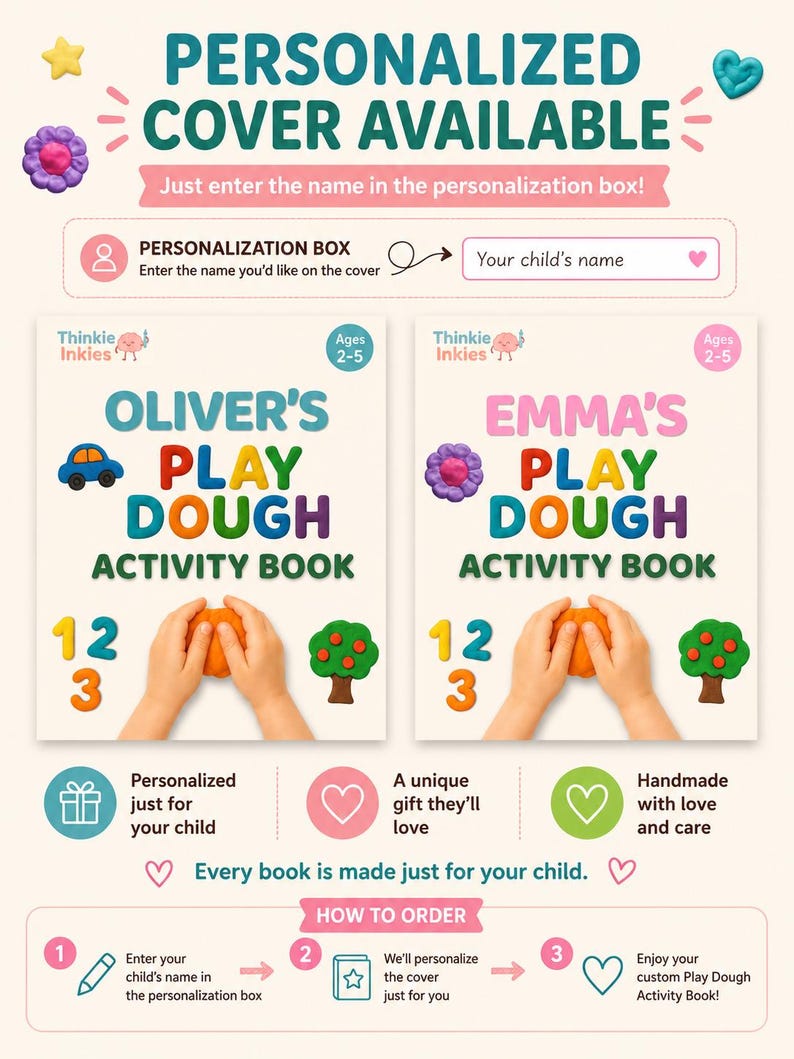
If your child likes shaping materials, explore the play dough activity book. Dough is supplied separately; check its age guidance and ingredients. A book is optional, and plain paper or a suitable mat works for many of these ideas.
For more purposeful invitations, see pretend-play writing. The next good activity is one the child is willing to share, not necessarily another tracing page.
Every child develops differently. Use age guidance, supervise activities and choose materials appropriate for your child and home.
Published by ThinkieInkies. General play ideas, not clinical advice. Product details are available in the linked product listings; general learning ideas are provided for inspiration and should be adapted to each child with adult supervision.