
A child can explore their written name before they are ready to write it. Name recognition activities focus on noticing and finding familiar print. They do not require careful pencil control, and they can fit into everyday play.
Start with the name your family actually uses. Write it clearly and consistently, preserving its spelling, accents, and capitalization. If your child's school uses a particular name form, coordinate with the teacher so the examples are easy to connect.
Begin with one meaningful label
Place a name card beside the child's own drawing. Say, “This says Maya. It tells us this is your picture.” The point is to show what the print does. You do not need to ask the child to identify every letter.
NAEYC notes that children's names can be meaningful starting points for early writing. Recognition games are one practical way to make that print familiar; they are not a guarantee of earlier reading. See NAEYC's emergent-writing guidance.
Try four games that do not need a pencil
Name-to-photo match. Put one family photo beside one written name. Make the pairing together. Later, offer two photos and invite the child to place the name beside the right person.
Find your place. Make large name cards for a pretend picnic. The child helps each toy or family member find a place. Read the names aloud rather than treating the setup as a quiz.
First-letter detective. Point out the first letter on the child's card. Look for that same shape in a book title or another family name. Keep the target card visible for comparison.
Same or different. Write the child's name twice using the same lettering. Put a third, clearly different name beside them. Ask which two look alike. If the child chooses differently, compare the cards together without announcing a score.
Separate recognizing the whole name from knowing letters
A child might find their name because of its length, first letter, or overall appearance. That is different from identifying every letter or reading unfamiliar words. You can build on the observation without overstating what it means.
Ask an occasional noticing question: “What do these two names have at the beginning?” Then give space for the child's own questions. Repeated testing can make a familiar label feel like a performance.
Offer a bridge to making marks
When your child wants to try writing, provide blank paper beside the name card. They might make an initial, several lines, or a drawing. Keep the reference available and let the attempt stand. Our long-name practice guide offers ways to reduce the amount of writing without changing the name.
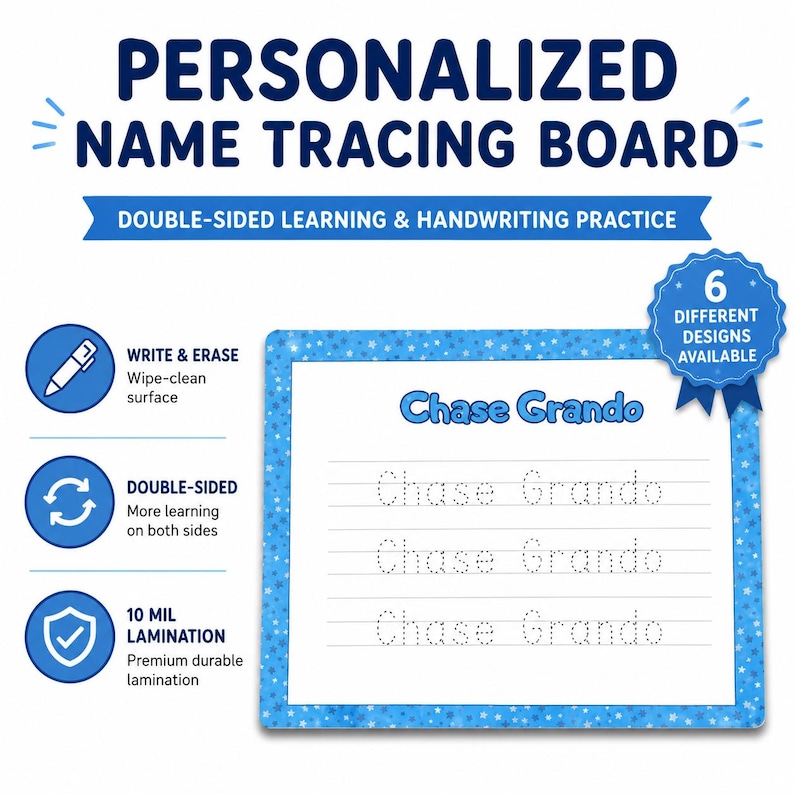
A personalized name tracing board can serve as a stable name reference before it is used for tracing. Check the product's age and supervision guidance, and keep any marker with the adult until needed.
When should recognition become tracing? When the child shows interest in making the marks. For a gentle introduction, use the existing short name-tracing routine.
Every child develops differently. Use age guidance, supervise activities and choose materials appropriate for your child and home.
Published by ThinkieInkies. General play ideas, not clinical advice. Product details are available in the linked product listings; general learning ideas are provided for inspiration and should be adapted to each child with adult supervision.