A pretend bakery can be a small shared game: one mat, some suitable dough, and a customer with an imaginary order. The child gets to shape, describe, choose, and change the story. You can bring in counting or written marks when the game creates a reason for them.
Keep real snacks separate. Explain that the dough is for pretending, check ingredients and age guidance, and supervise closely. Skip dough if the child is likely to eat it.
Set up three jobs
Make space for a baker, a customer, and a place to put finished orders. A folded piece of paper can be the menu; an unbreakable tray can hold the pretend goods. Avoid coins, beads, or other tiny pretend-money pieces.
Let the child choose a role. An adult can be the customer at first, then swap. There is no requirement to complete every job or create realistic food.
Place an order with one detail
Try “one round cake” or “two long rolls.” If the child wants to make something else, ask what is available today. Follow the menu they invent.
Describe what you notice: “That one has a tall middle.” Leave pauses for the child to respond. Shared play offers chances for back-and-forth communication, as explained in the American Academy of Pediatrics' communication-through-play guidance. No particular toy is needed for those exchanges.
Add counting when there is a customer problem
Imagine that two toys arrive and each needs one item. Ask the baker how to make sure both have something. Match one item to each toy before adding more number talk.
If the child wants an order slip, draw two large marks or write 2 beside a picture. The slip becomes a useful reminder. It does not need to become a formal arithmetic exercise.
Make a menu that belongs to the child
Invite a drawing of the bakery's specialty. Write the child's description beneath it if they want you to. They can add a name, a price-like mark, or a signature of their own.
See our pretend-play writing guide for ways to leave room for drawings and dictated messages. The child's marks can remain visible even when an adult adds conventional words elsewhere.
End the story clearly
Announce that the bakery is closing, fill the final pretend order, and put the dough away according to its instructions. Wipe the surface and wash hands. A closing role can make cleanup part of the game rather than a sudden interruption.
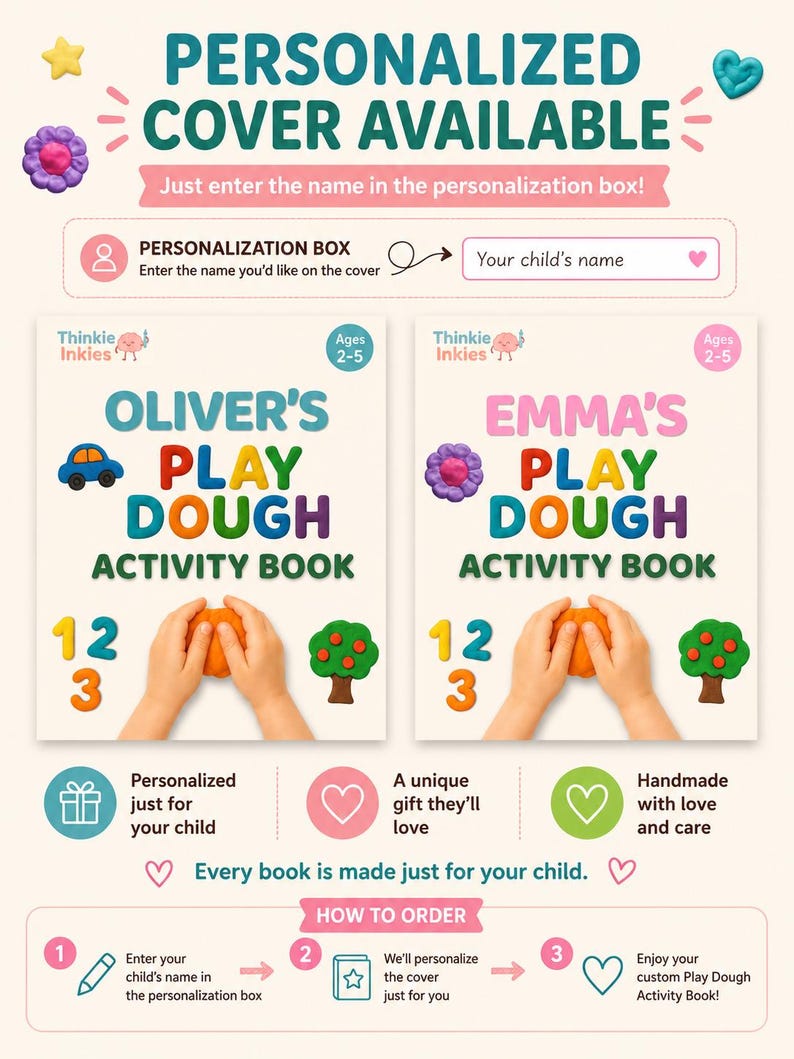
For prepared scene prompts, browse the play dough activity book and check the actual page examples. A plain suitable mat works too.
What if my child only wants to squash everything? Let the bakery become a mixing shop or a dough factory. You can describe, take turns, and enjoy the shared activity without protecting an adult-designed final product.
Every child develops differently. Use age guidance, supervise activities and choose materials appropriate for your child and home.
Published by ThinkieInkies. General play ideas, not clinical advice. Product details are available in the linked product listings; general learning ideas are provided for inspiration and should be adapted to each child with adult supervision.