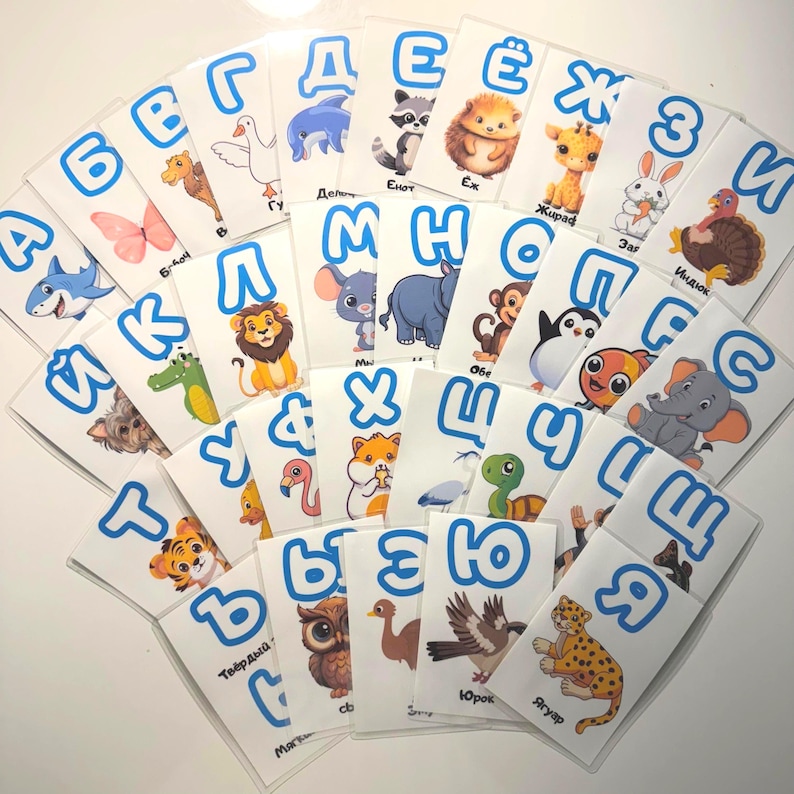
Some printed Russian and English letters look alike, which can make two alphabet charts an interesting comparison game. Their appearance does not always tell you their sound. Keep the language clear and use a fluent speaker's pronunciation when you need a model.
For a preschooler, the first goal can simply be noticing that a family uses more than one writing system. There is no need to memorize a table of confusing letters in one session.
Compare a few clear examples
| Printed form | In English | In Russian |
|---|---|---|
| B / В | English B can represent the sound in “ball” | Russian В commonly represents a v sound |
| H / Н | English H can represent the sound in “hat” | Russian Н commonly represents an n sound |
| P / Р | English P can represent the sound in “pen” | Russian Р commonly represents an r sound |
These are introductory comparisons, not a complete pronunciation guide. Sounds depend on language and context, and English letter-to-sound relationships are not always one-to-one.
Give each example a language context
Put a small “English” label beside one example and “Russian” beside the other. An adult reads a familiar word containing the letter in the appropriate language.
Avoid presenting an isolated shape and asking the child for one supposedly correct sound without saying which language is intended. That question can be ambiguous even when the child understands both systems.
Use familiar names carefully
Compare a family member's name in the forms the family actually uses. Ask what looks similar and what changes. Do not invent a transliteration rule from one example; names can have established spellings that do not follow a child's first guess.
Let the child point, circle a matching shape on separate paper, or describe a difference. Recognizing a shape and reading a name remain different experiences.
Turn confusion into comparison
If a child gives the English sound while looking at a Russian card, say, “That is how this shape can work in English. Here we are reading Russian.” Model the example once and continue the game.
Avoid treating a cross-language response as proof of a problem. ASHA explains that using multiple languages does not itself cause language delay; its family guidance is a useful reference if relatives are worried about mixing languages.
Use cards as one part of a language-rich routine
The Russian alphabet cards can provide a physical reference. Check the current lettering, illustrations, and format before ordering. For additional games, use the existing Russian flashcard activity guide.
Follow the cards with a familiar song, a story, or a message to a relative in Russian. Our bilingual home-literacy routine offers ways to make the language useful beyond a card game.
Every child develops differently. Use age guidance, supervise activities and choose materials appropriate for your child and home.
Published by ThinkieInkies. General play ideas, not clinical advice. Product details are available in the linked product listings; general learning ideas are provided for inspiration and should be adapted to each child with adult supervision.