
Guided play combines an adult's learning invitation with room for a child to choose and explore. A worksheet usually presents a more fixed task. Neither label tells you everything about the experience: a page can become a playful conversation, and an elaborate toy can still be used as a rigid drill.
Choose the format by what the child can actually do with it and how the adult responds.
Three ways to use the same idea
Imagine the topic is shapes.
In free play, a child builds whatever they want with suitable blocks. The adult may simply join and respond.
In guided play, the adult offers a challenge such as making a home for a toy, then asks about the pieces the child chooses. The child still controls much of the design.
On a worksheet, the child might be asked to circle all the triangles. That can be a short activity if it interests them, but it offers fewer choices unless the adult opens it up.
What does research support?
A systematic review of guided play examined 39 studies and included 17 in its meta-analysis. Compared with direct instruction, guided play showed advantages for early math, shape knowledge, and switching between tasks. Compared with free play, it showed an advantage for spatial vocabulary. Differences were not found for other key outcomes, and the activities varied across studies.
Those findings support trying purposeful, flexible play around a specific goal. They do not show that guided play is always superior, that every activity works equally well, or that a branded workbook has been tested. A shape-building conversation is a plausible home application of the approach, not a reproduction of an entire research intervention.
The American Academy of Pediatrics also emphasizes the broad developmental value of play with adults and peers. Those benefits concern varied play experiences, not a guaranteed result from buying a particular product.
Turn a page into an invitation
Open a matching page and ask the child which picture they want to explore. They might point, invent a story, find a similar object nearby, or make their own match on paper.
If the page asks for tracing, let the child draw a new route beside the example. If it asks for counting, bring a small group of suitable real objects into the conversation. A printed prompt can be the beginning of an activity rather than its entire boundary.
Know when a page is not the right tool
Choose movement when a child wants to move, construction when they want to build, and conversation when they want to tell a story. An activity book should not consume the time that would otherwise go to outdoor play, relationships, rest, and open exploration.
When every page requires bargaining, change the plan. Our alternatives for children who dislike tracing show how to keep the underlying idea while changing the task.
Where a reusable book fits
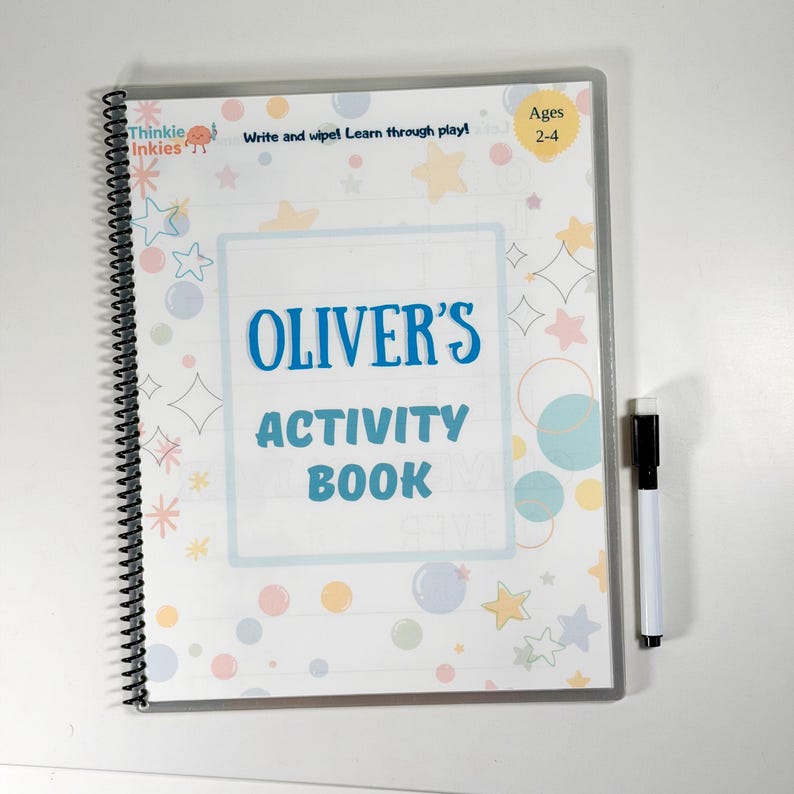
A write-and-wipe activity book can provide prepared prompts when a family wants a convenient starting point. Preview the pages and choose one that matches the child's current interest.
Then use a five-minute learning rhythm if a small routine helps. Five minutes is a practical example, not a research-defined dose. The quality of the interaction matters more than making the timer run.
Every child develops differently. Use age guidance, supervise activities and choose materials appropriate for your child and home.
Published by ThinkieInkies. General play ideas, not clinical advice. Product details are available in the linked product listings; general learning ideas are provided for inspiration and should be adapted to each child with adult supervision.