
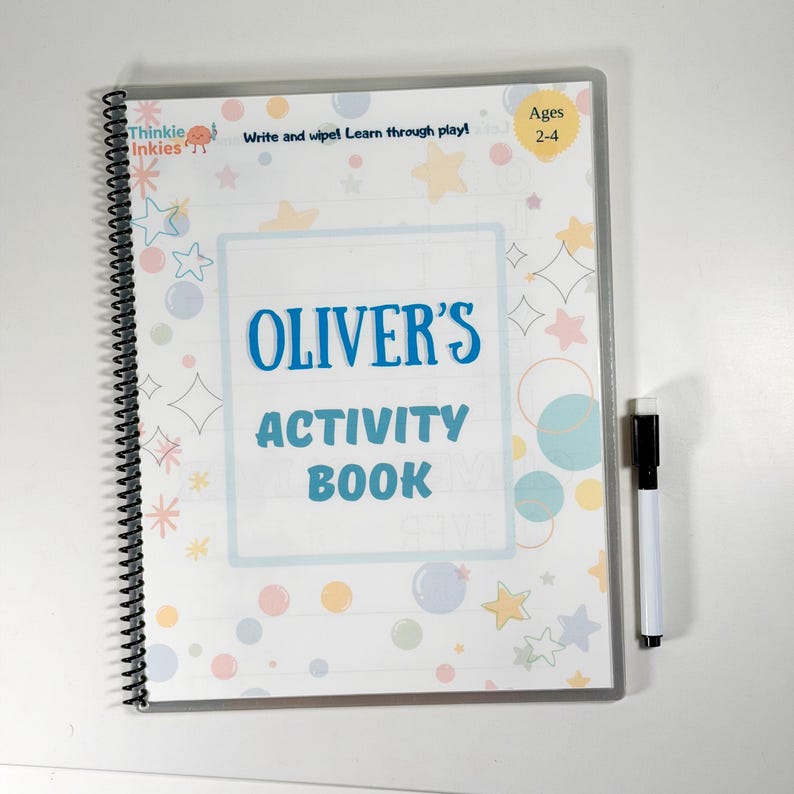
Pre-writing line activities give children something simple to do with a drawing tool before a page asks for recognizable letters. The useful question is not whether a line is perfect. It is whether the child can explore starting, moving, changing direction, and stopping with interest.
You only need paper and an age-appropriate drawing tool. An adult should supervise materials and keep marker caps or other small accessories out of reach.
Six invitations to make a mark
Rain for a garden. Draw a cloud near the top of the page and a garden below. Invite the child to add falling rain. Model one downward line, then let the rain take its own shape.
A road to a house. Put two large drawings on opposite sides of the paper. Ask, “How could the car get home?” Begin with a straight route. Later, offer a turn or a gentle bend.
Hills for a hiker. Draw two broad curves. Walk your fingers over the hills, then invite the child to add another hill. Avoid making the paths so narrow that the task becomes staying between boundaries.
A blanket for a toy. Draw a rectangle and add a few lines across it. The child can choose stripes, short marks, or an entirely new pattern. Name the movements while drawing alongside them.
A snail's trail. Draw a very large spiral and follow it with a finger. Offer space for a separate trail rather than requiring an exact copy. If the spiral feels complicated, return to a single curve.
A delivery map. Draw a starting point and two destinations. Let the child choose where to deliver an imaginary parcel and make the path. Here, the mark has a purpose beyond finishing a line.
Adjust one feature at a time
Make a path broader, shorter, or simpler when the child seems frustrated. Increase only one challenge if they ask for more. A longer road with several turns and a smaller drawing tool changes several demands at once, making it harder to see what helped.
Try the same invitation at a different scale. A large sheet may suit broad movements; a small card may make one quick task feel manageable. Neither size is automatically better. Let comfort and interest guide the choice.
Connect paths to letters without forcing the connection
If the child notices that a line resembles part of a letter, explore that observation. You might say, “Your road has a tall line like the beginning of this letter.” There is no need to announce that every drawing is preparation for school.
For decisions about introducing actual letters, read when to start tracing. For a reason to use marks during play, try pretend-play writing ideas.
Reuse a favorite prompt
Families who want prepared options can look at printable tracing cards. Check the file format, printing requirements, and any recommended protective sleeve or marker instructions. Printed paper itself is not wipe-clean.
Should we finish every card? No. Choose the path the child wants to revisit. A small, enjoyable drawing invitation is enough for one session.
Every child develops differently. Use age guidance, supervise activities and choose materials appropriate for your child and home.
Published by ThinkieInkies. General play ideas, not clinical advice. Product details are available in the linked product listings; general learning ideas are provided for inspiration and should be adapted to each child with adult supervision.