
A repeating pattern has a part that happens again in the same order. For preschool play, make that repeated part easy to hear or see. A clap followed by a tap, repeated several times, can be a clearer starting point than a crowded worksheet.
The aim is to notice the repeat. It is not to complete increasingly long sequences as quickly as possible.
Begin with your bodies
Try clap, tap, clap, tap. Use comfortable movements that fit the child and the space. Say the actions as you do them. After several repeats, pause and invite the child to show what comes next.
If they invent a different sequence, enjoy it as a new pattern. Ask them to demonstrate the part that repeats. This keeps the game collaborative instead of making the adult's pattern the only acceptable answer.
Build a two-shape train
Use large paper circles and squares. Arrange circle, square, circle, square. Leave two pieces nearby so the child can choose how to continue.
Point to one circle and one square together: “This part repeats.” Marking the repeated unit can make the idea clearer than naming every piece independently.
Keep the pieces large and supervise the activity. You can draw the shapes instead if loose materials are not appropriate for your child.
Make the pattern audible
Invent a toy parade: bear says “hello,” rabbit says “hop,” then the pair repeats. Let the child choose the voices. The toys are optional; drawings or your own gestures work too.
An audible pattern provides another way to join if arranging pieces is frustrating. You can also let the child point while an adult performs the sounds.
Add a missing piece after the repeat is familiar
Build a short sequence and cover one part with a large sheet of paper. Ask what might be underneath. Uncover it together and compare the whole sequence.
Do not introduce hidden pieces, extra colors, and a longer repeating unit all at once. Change one feature so the activity remains easy to understand.
Avoid a common sorting mix-up
A pile of red shapes beside a pile of blue shapes is a grouping, not necessarily a repeating pattern. Both are worthwhile activities. Name what you are doing so the child sees the difference.
For grouping ideas, use our color-sorting guide. For describing the shapes themselves, try shape exploration beyond flashcards.
Add a reusable surface if you want one
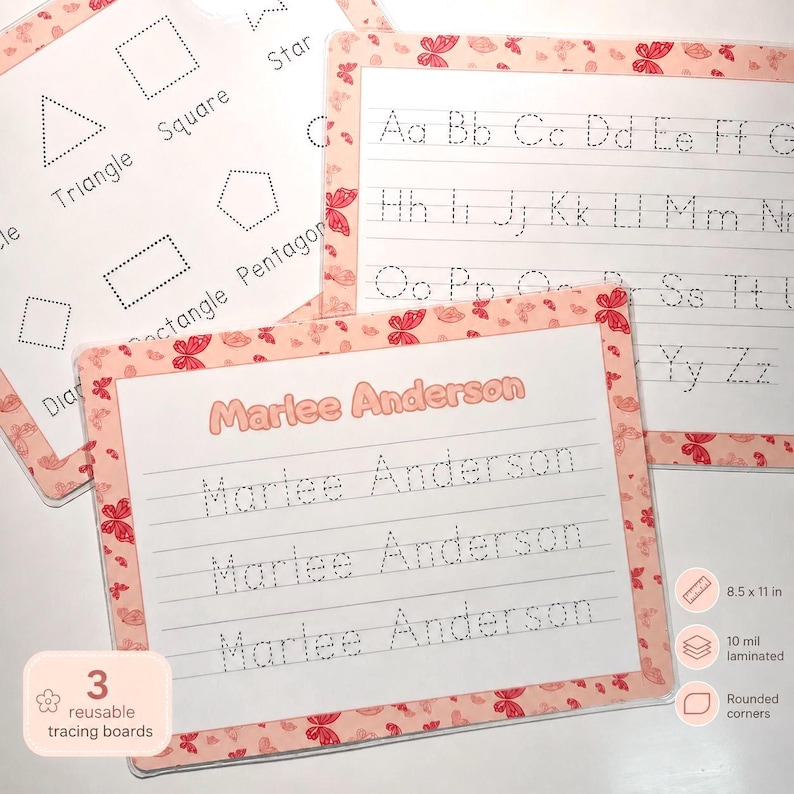
An adult can draw a short pattern on a compatible reusable board, following its marker and care instructions. The tracing boards set is one option to inspect; check the available writing space rather than assuming it contains a dedicated pattern page.
When should we try a harder pattern? When the child wants a new challenge. They can choose a three-part repeat or create their own rule. Returning to a familiar two-part pattern remains a perfectly useful way to play.
Every child develops differently. Use age guidance, supervise activities and choose materials appropriate for your child and home.
Published by ThinkieInkies. General play ideas, not clinical advice. Product details are available in the linked product listings; general learning ideas are provided for inspiration and should be adapted to each child with adult supervision.